The Core Agent Loop
How Every AI Agent Works
Section titled “How Every AI Agent Works”No matter which platform you use, whether it is Claude, ChatGPT, Gemini, or a local model, every AI agent follows the same fundamental pattern. We call this the core agent loop. Once you understand this loop, you understand how all agents operate.
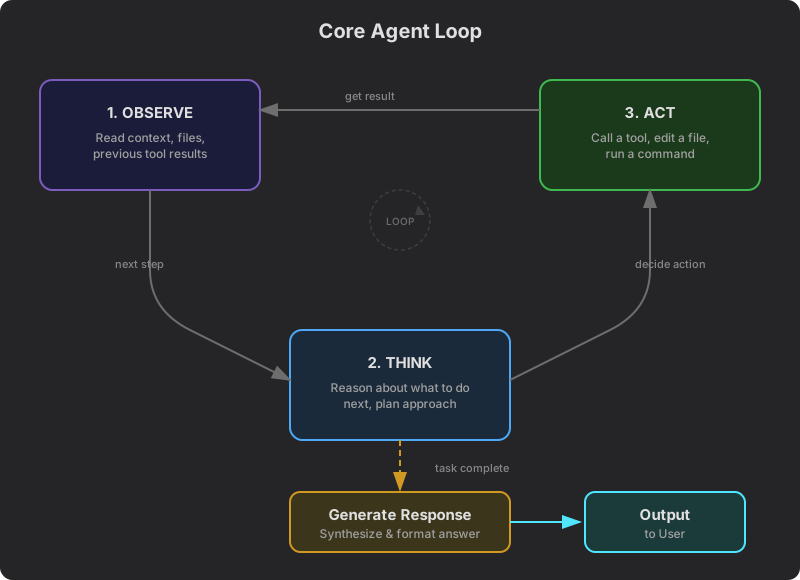
When you give an agent a task, it does not try to solve everything in a single step. Instead, it enters a cycle that it repeats over and over until the work is complete. Each pass through the cycle brings the agent closer to finishing your request.
The Three Steps
Section titled “The Three Steps”OBSERVE: Gather Context
Before the agent can do anything useful, it needs to understand the situation. During the Observe phase, the agent reads and absorbs everything relevant to the task.
What the agent observes:
- Your instructions. The goal you described and any specific requirements you mentioned. This is the starting point for everything the agent does.
- Previous results. If the agent has already completed earlier steps, it looks at what it produced. Did the last action succeed? Did it return useful information? Were there errors?
- Files and documents. If you asked the agent to work with existing content, it reads those files to understand what it is working with.
- Configuration and memory. Many agents have access to memory files that tell them about your preferences, your project, or how you like things done. The agent reads these to personalize its approach.
- Environment information. The agent may note what tools are available to it, what platform it is running on, or what constraints exist.
Think of this step like a worker arriving at their desk in the morning. Before starting any tasks, they review their notes, check their email, look at what was accomplished yesterday, and understand what needs to happen today.
THINK: Plan the Next Move
Once the agent has gathered context, it reasons about what to do next. This is where the intelligence of the language model comes in. The agent does not follow a rigid script. It makes a judgment call based on everything it observed.
What happens during the Think phase:
- Assessing progress. The agent asks itself: Am I done? Is the task complete? If yes, it exits the loop and delivers the final result. If not, it keeps going.
- Identifying the next action. Based on the current state, the agent decides the single most useful thing it can do right now. Should it search for information? Write a draft? Edit an existing file? Ask for clarification?
- Considering alternatives. If the previous action did not work as expected, the agent adjusts its plan. It might try a different approach or break the problem into smaller pieces.
- Evaluating risks. Good agents consider whether an action might cause problems. Should it overwrite a file, or create a new one? Should it ask the user before making a big change?
This step is what separates an AI agent from a simple automation script. A script follows the same steps every time regardless of what happens. An agent adapts. It thinks about what makes sense given what it knows right now.
ACT: Execute the Decision
The agent takes the action it decided on during the Think phase. This is where tools come into play. The agent does not just generate text here. It can interact with the outside world.
Types of actions an agent can take:
- Call a tool. Search the web, read a file, write to a document, send a request to an API, or run a command.
- Generate content. Write text, create a summary, draft an email, or compose a social media post.
- Edit existing content. Modify a file, restructure a document, or update a configuration.
- Request information. Ask the user a clarifying question if the agent realizes it does not have enough information to proceed.
After the action is complete, the agent goes back to Step 1 (Observe) to see the result of what it just did. This creates the loop.
The Loop in Action
Section titled “The Loop in Action”Let’s walk through a concrete example. Suppose you ask an agent: “Create a summary of the meeting notes in my documents folder and email it to my team.”
- Observe: The agent reads your instruction and checks what files are in the documents folder.
- Think: It identifies three meeting note files and decides to read the first one.
- Act: It opens and reads the first file.
- Observe: It now has the contents of the first file in its context.
- Think: It decides to read the second file before writing any summary.
- Act: It opens and reads the second file.
- Observe: It now has two files worth of content.
- Think: It reads the third file to have complete information.
- Act: It opens and reads the third file.
- Observe: It has all three files. It decides it has enough context to write the summary.
- Think: It plans the structure of the summary and considers the audience (your team).
- Act: It writes the summary document.
- Observe: The summary is complete. It checks if it covers all key points.
- Think: The summary looks good. Now it needs to send the email.
- Act: It drafts and sends the email with the summary attached.
- Observe: The email was sent successfully. The task is complete.
- Final output: The agent reports back to you that the summary has been created and emailed to your team.
Notice how the agent made multiple passes through the loop. It did not try to do everything at once. It broke the task into logical steps, executed each one, checked the result, and moved on.
When Does the Loop End?
Section titled “When Does the Loop End?”The agent exits the loop when one of these conditions is met:
- The task is complete. The agent has accomplished everything you asked for and delivers the final result.
- The agent needs your input. It has reached a point where it cannot proceed without more information or a decision from you.
- A limit is reached. Some platforms set limits on how many loop iterations an agent can perform in a single run, to prevent runaway behavior.
- An unrecoverable error occurs. The agent tried multiple approaches but could not complete the task, so it reports what happened and what it tried.
Understanding this loop gives you a mental model for working with any AI agent. When an agent seems stuck or produces unexpected results, you can think about which phase might be going wrong: Is it not observing the right context? Is it making poor decisions in the Think phase? Is it using the wrong tools in the Act phase? This framework helps you troubleshoot and improve your results.